21 February 23
“Growing up, my father woke up early every morning and would be out of the house by 7am to go to work and provide for us.
“My mother wouldn’t be far behind. She started as a basic post office worker but eventually worked her way up to become a manager. That made me very proud. They both make me feel proud.”
Born in Cherkasy, located in central Ukraine on the banks of the Dnieper River, the Mykolenkos lived humbly in a rented apartment in one of the city’s poorer districts.
Outside their apartment block sat a makeshift football pitch, where dense foliage bordered a scorched pitch to allow Vitalii and his neighbours a place to play with the one communal ball.
It was there he began to fall in love.
“I was six years old when I started playing football there,” he recalls. “But I always played with the older kids.
“I always seem to gravitate towards people older than me, even now I am younger than nearly all of my friends.
“They are good memories of playing outside our apartment block and in the streets when I was a kid.
“That is all we did because there were no laptops, no video games.
“I had never really thought about football until I started playing there but I really enjoyed it straight away.
“I’ve always relied on hard work, even back then. I had to because I didn’t have a lot of skills and I was playing with older kids, so my thing was always playing hard, playing tough, never stopping.”
After a brief fling with table tennis and a “stupid” urge to pursue it, things were taken up a notch when a football coach visited Mykolenko’s primary school in a bid to recruit new players.
“That first session was a typical case of excited kids!” he smiles. “Again, there was only one ball and everyone wanted a touch so we were all crowding around in a big bunch.
“From there I joined my first team. We didn’t always have money for a pitch so we had to use the environment around us to get better.
“Sometimes the coach would take us on runs through the forest and I don’t think they were necessarily to get fitter but to make us stronger mentally. They were tough runs in tough conditions.”
Keen for more, Mykolenko, aged 11 at the time, spotted an advert for trials while browsing Dynamo Kyiv’s official website.
Kyiv, however, was a three-hour drive away from their home and despite offering their support to Mykolenko in all of his pursuits, his parents needed to be convinced of their son’s commitment before making a significant journey north.
“My mum drove me up to Kyiv and I took part in the trials,” he explains, but what came next would prove to be life- changing.
“At the end of it they told us that we should all move to Kyiv,” says Mykolenko. “They said I needed to be with my parents because I was a year too young for their academy, so I’d need to do the first 12 months with my parents.
“Of course, it was a huge thing but because my parents never owned their apartment, so they said, ‘Okay, we’ll find a place to rent in Kyiv instead’.
“It felt important at the time but looking back that was huge... It was already a tough time for my parents because we had no money but it meant leaving everything behind, including their jobs.”
Mykolenko was inducted into Dynamo Kyiv’s academy — a special school where players combine classroom studies and football — aged 12.
“I know a lot of people say, ‘I would like to go back to the days when I was in school’, but, no, I don’t want this!” he insists. “I found it tough.
“Every day I would have to be at breakfast for 7.40am, then straight to school. I didn’t like school at all.
“We would study until around 3pm, then straight from there we’d go to the training ground to eat and then start training at 5 or 5.30pm.
“That would be six days a week, only on Sundays we would be off.”
That endeavour would pay off handsomely, with Mykolenko rising through the ranks to the first team of the 16-time Ukrainian champions.
Departing Ukraine's capital 13 months ago, the now 24-year-old had amassed 132 senior appearances for Dynamo Kyiv, lifting the league championship, the Ukrainian Super Cup and two Ukrainian Cups along the way.
The move to Merseyside would prove to be a major culture shock, even before the deeply unsettling conflict began, but Mykolenko says his feelings for the Club and the area have deepened quickly.
“Everything,” he answers, without hesitation, when asked about the differences between life and football in Ukraine and England.
“First and foremost, the language,” he says in near-perfect English, with this sit-down interview at Finch Farm taking place without an interpreter.
“It was a big problem for me. It still is to a certain degree because everyone has different accents here and it’s not so easy to understand everyone perfectly but it’s getting better all of the time.
“The Scouse accent? Woah! It’s the same in the east of Ukraine. I am Ukrainian, I can speak in Ukrainian and Russian but when I go to the east of Ukraine the accent is so strong and they have different words for things... It’s similar in Scouse.
“The main way I’ve improved, as well as being around my teammates, is by watching Netflix. I try to watch in English as much as I can but if I’m tired, I’ll watch in Ukrainian with English subtitles. When I do that, I find myself reading the English more than watching the shows, so that’s helped me a lot.
“I think the one thing that maybe helped me was coming from Dynamo Kyiv, a big club in Ukraine with a big culture, big fanbase and rich history, to a club in Everton with the same qualities... It made it a little bit easier in terms of what to expect and what comes with playing for a big club like this.
“I honestly believe football is like a religion in England. I think the difference is in Ukraine, most people are so focused on working every day because you need to make enough money to live.
“Of course, the Dynamo Kyiv fans and the fans of the national team are really good but our fans — Evertonians — are amazing because they live with us every single day.
“They live with their Club for every moment, good and bad, and this means so much as a player to know you have that level of support and responsibility.”
Mykolenko, who reveals he is now supporting fellow countrymen Mykhaylo Mudryk and Illya Zabarnyi adapt to life on English shores following January moves to Chelsea and Bournemouth respectively, prefers to live a quiet life away from football.
Away from the Premier League spotlight, he likes to spend time with his girlfriend and dog, a large Cane Corso named Balu - after a bear - although progress to train his pet as a security dog has been slow because he is "too soft!"
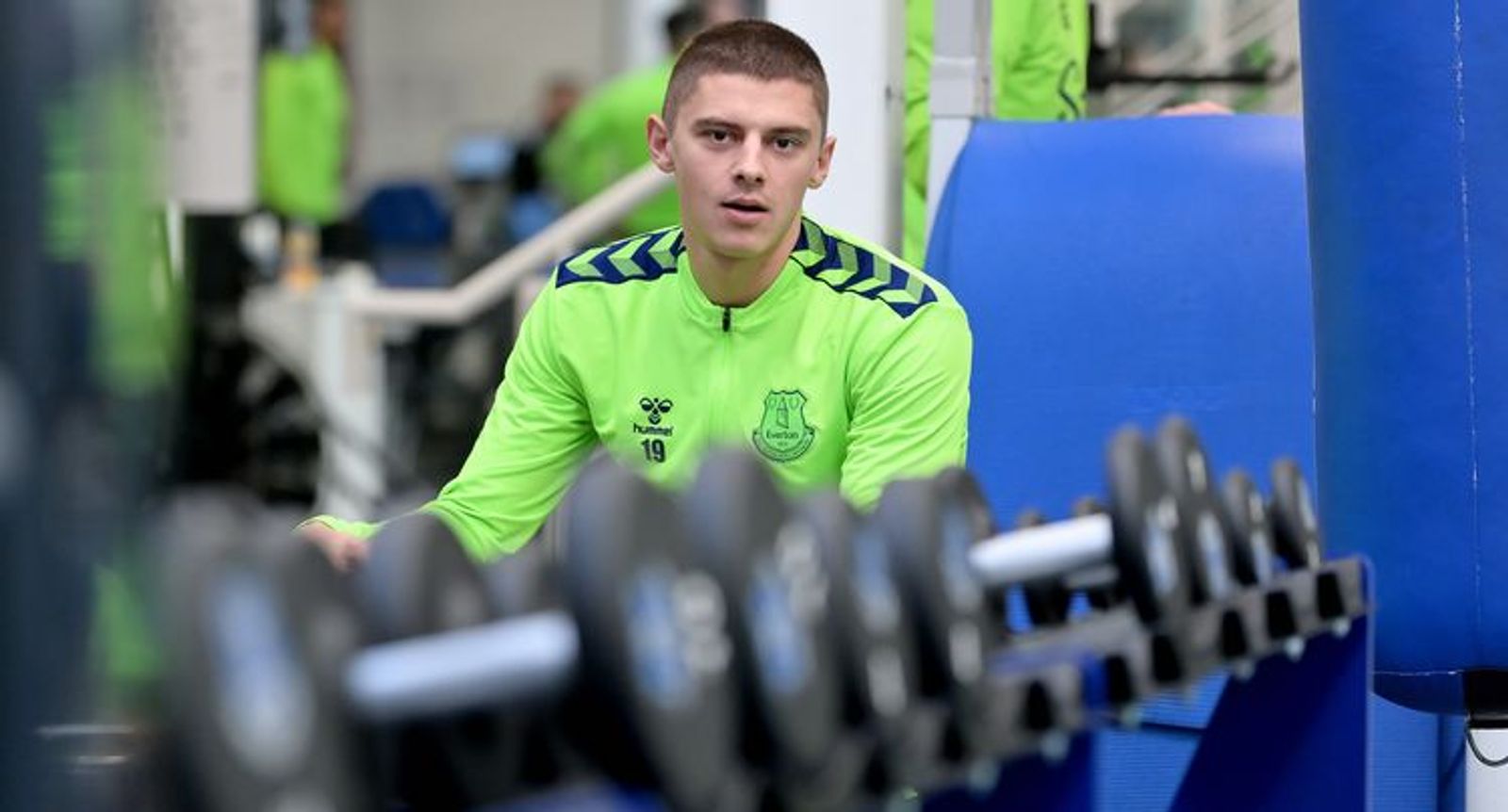
Those obedience sessions prove a welcome change of pace for Everton’s number 19, who has overcome a host of significant hurdles on and off the pitch since his move to Goodison Park.
“I love Everton. How can I not?” he reflects. “It makes me very proud to represent this club, a big club.
“From the first day I arrived, everyone welcomed me with open arms. My mind was blown, to be honest. I remember walking around the training ground and everyone was welcoming me... ‘Alright, lad!’... ‘You good, son?’... It was a lot to take in but it meant everything to me.
“I love my teammates - every one of them - and all of the staff here. The fans, too. I think they have respect for me and I have incredible respect for them.”
The stature of the Club was reinforced when his father, Sergei, was eventually able to make his first trip to the north west of England last month.
“I like Liverpool as a city,” he reveals. “I like to go for a walk around the city sometimes and I enjoy the restaurants, too.
“Now it’s a little different but I liked in the first month or two I could walk around and nobody knew me.
“When my father visited me, we drove into the city centre to go to Everton Two in Liverpool One. It was a crazy feeling because as we entered the shop it felt like I’d just walked into my house where all my friends were waiting for me.
“Everyone welcomed me... ‘How’s it going, Myko?’... I’m quite a quiet guy and I like to keep myself to myself, so I love that they have that relationship with me but I also feel quite shy!
“My dad was completely shocked that everyone knew me, everyone knew my name and wanted to make sure I was okay.
“Of course, we’d spoken about what it was like but for him to see it for himself took him by surprise.
“He told me afterwards that it makes him very proud that I am part of such a big club and I think that gave him another glimpse of what sort of club Everton is.”
Back home, Mykolenko’s parents are faring relatively well considering the ongoing war.
“They are in Kyiv now, well, just outside the centre... Like Formby is to Liverpool,” he explains, with a typically conscientious answer.
“I like to speak with them every day face to face but not a day goes by without us being in contact.
“They are not okay, but relatively okay, I guess. Normal. In Ukraine, now the biggest problem is electricity and the lack of it.
“I’m really happy because my parents now live in a house, rather than an apartment, and they have their own fireplace. This is so important when there is no electricity.”
Back to Everton matters and the impressive 1-0 home win over Arsenal in manager Sean Dyche’s first game in charge of the Club earlier this month was seen as a new benchmark in the Blues’ changing room.
Mykolenko says the confidence from that early win has been important, but insists there remains a collective determination burning within the group to correct the Club’s league position as quickly as possible.
“A fresh start under him? Yes,” he ponders. “The gaffer loves discipline and I’ve always said that this is something I hold extremely important, too.
“Discipline for a defender is number one, in my opinion.
“You need to be consistent and you need to be concentrating every moment of the game. Discipline is important across the pitch, though, not just in defence.
“I know he can make me better, for sure. He has different ideas and you can always learn things from a new manager, like I am doing now.
“I get a good feeling.
“We know there will be tough work. My last 18 months at Dynamo Kyiv I worked with Mircea Lucescu who was a very good coach. Every session, we would run seven or eight kilometres each session. Now it’s similar. They are tough sessions but rewarding ones.
"When you have these kind of sessions, I feel like you can really feel the benefit when the games come around. In the last 20 minutes, you can run harder like it’s the first 20 minutes. That is a big advantage.
“Where we are at the moment is not our place, it’s not where we want to be or where Everton deserves to be.
“We should be better but we will fight to get there.”





















© Copyright 1878 - 2026 Everton Football Club